A20 · Reference edition 2026.11
Redundant constraints — Review and interpretation
Two contacts intended to locate the same direction can compete when the part or fixture varies. More contacts do not guarantee better repeatability.
Scope and purpose
Review the record before drawing a conclusion. Look for missing context, ambiguous labels and claims that exceed the evidence. The purpose is to identify what can be understood from the record and what still requires a separate assessment.
Working notes
This reference collection concerns light, offline dimensional-inspection layouts. It brings locating concepts, component descriptions and revision records together without substituting for an engineered fixture design. The drawings are original explanatory diagrams. Reference IDs identify documents, not commercially tested products. Read the scope and limitations alongside each example, and keep the actual part drawing and inspection requirements available when reviewing a proposed layout.
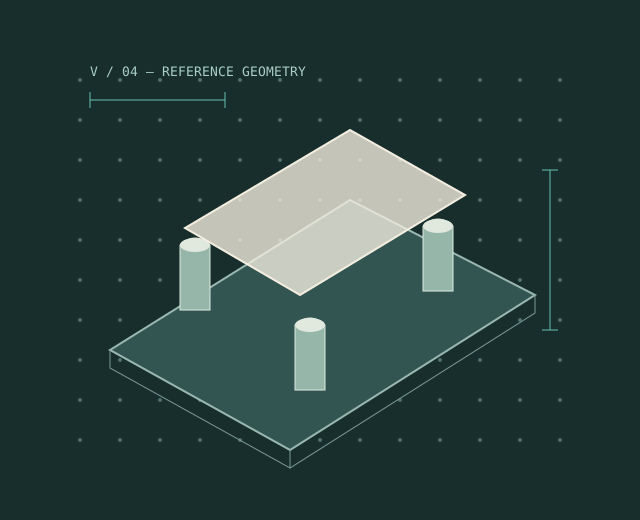
Practical example
Highlight contacts sharing a normal direction and describe whether each is locating, supporting or floating.
| Reference record | Interpretation |
|---|---|
| A20 | Redundant constraints |
| Scope and purpose | Two contacts intended to locate the same direction can compete when the part or fixture varies. More contacts do not guarantee better repeatability. |
| Limits and interpretation | Do not remove or relax a real constraint without an engineering review. |
Review checklist
Read the record without relying on memory; check every label; identify uncertainty; decide whether a specialist review is required; retain the original observation.